
Japan Allergen Labeling Rules 2026: Restaurants and Takeout
 Daiki Kobayashi · Founder of WE TABLE
Updated · 8 min read
Products in Japanese supermarkets and convenience stores have allergen labels. So many visitors assume that food in Japan is labeled wherever you buy it or eat it. In fact, labels are required only on processed food sold in a container or package. Japan’s labels also have a level of their own: “recommended.” This article explains both lines before your trip.
What food has to show allergens in Japan?
Japan’s food allergy labeling is set by the Food Labeling Standards, under the Food Labeling Act. The labeling duty covers processed food in a container or package. Examples are bagged snacks, packed side dishes and bottled drinks sold in supermarkets, convenience stores and station kiosks.
In this article, “labeling duty” means the duty to show allergens. The ingredient list is set by the same standards, but its scope is a little different. Only one difference matters for travelers. Food such as a bento that a shop makes, packs and sells in the same shop does not need an ingredient list, but it must show allergens. So you may find an allergen label on a product with no ingredient list.
Even on a small package with a label area of 30 cm² or less, allergens cannot be left out. Some additives do not need to be listed, such as processing aids and carry-over additives. But if they contain a mandatory allergen, the allergen must still be shown. Where allergens can hide inside compound ingredients and additives is explained in hidden allergens on Japanese food labels.
Mandatory vs recommended allergens: Japan’s two levels
Japanese labels have two levels.
| Level | Items | On the label |
|---|---|---|
| Mandatory (9 items, “specified ingredients”) | Shrimp, crab, walnut, wheat, buckwheat (soba), egg, milk, peanut, cashew | Always shown when present |
| Recommended (20 items, “equivalent to specified ingredients”) | Almond, abalone, squid, salmon roe, orange, kiwifruit, beef, sesame, salmon, mackerel, soy, chicken, banana, pistachio, pork, macadamia, peach, yam (yamaimo), apple, gelatin | Makers are asked to show them where possible. Leaving them off is not a violation |
Cashew became mandatory on April 1, 2026, with a transition period until March 31, 2028. Pistachio was added to the recommended list on the same day.
Many products do show the 20 recommended items. But if a maker decides not to, they are not shown. No label does not mean the food is free of them. If you are allergic to soy, sesame, salmon or nuts, read not only the allergen part of the label but the whole ingredient list, to the end.
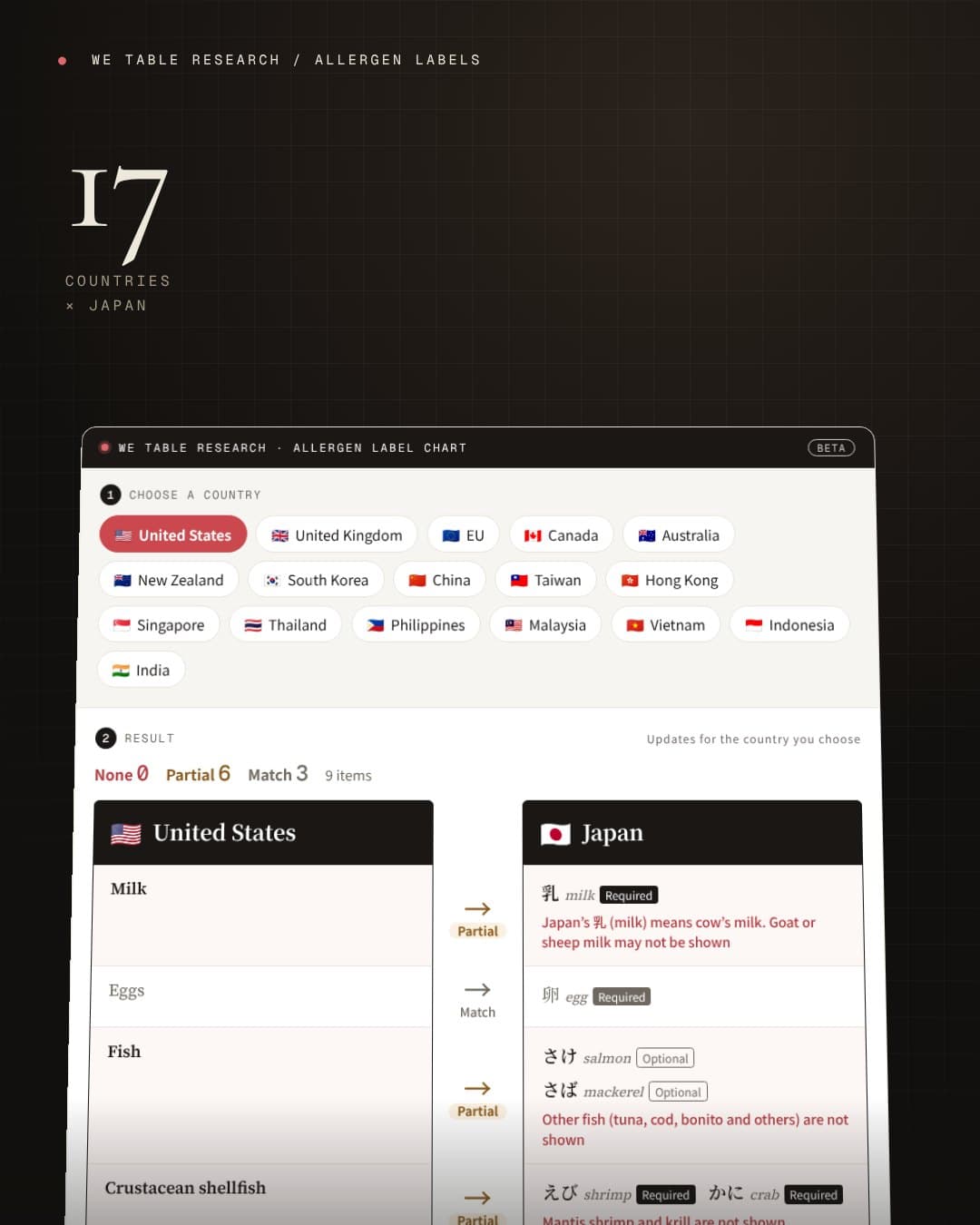
Among the countries and regions we compared, Japan was the only one with a “recommended” list on top of its mandatory list. In the others, the listed items must be labeled. (In China, allergen labeling itself is now only recommended. It becomes mandatory in March 2027.) To see how your own country’s labels look in Japan, use our country-by-country allergen chart.
We could not prove a recommended item was not in our food
At WE TABLE, we once tested a bento business for companies, called WE TABLE BOX. (It is not taking orders now.) The hardest problem was that we could not prove a recommended item was not in the food. I describe how we traced ingredients from each maker back to its suppliers in hidden allergens on Japanese food labels.
Takeout and restaurants: no label is not a violation
Outside packaged food, the labeling duty ends. Here is how it works, by the way the food is sold.
| How the food is sold | Allergen labeling duty |
|---|---|
| Packaged products in supermarkets and convenience stores | Yes |
| Bento and side dishes a shop packs in advance and sells in the package | Yes (the ingredient list can be left out, but allergens are required) |
| Food a counter-service shop packs ahead of busy hours, only for that day’s sales | No |
| Bento and side dishes packed when you order | No |
| Food sold loose, by weight or by the piece, without a package (bread, side dishes and so on) | No |
| Dishes you eat in a restaurant, and restaurant delivery | No |
| Alcoholic drinks (beer, sake, wine and so on) | No |
If a restaurant packs dishes in advance and sells them in the package, they need a label. But for food you eat in the restaurant, there is no duty to show allergens on the menu. The Consumer Affairs Agency says restaurants should ideally share this information on their menus, and more chain restaurants now have allergen charts. But this is each restaurant’s own choice.
What to watch for, even when there is a label
- Recommended items may be missing: as explained above.
- Cross-contact warnings are voluntary: notes such as 「本品製造工場では〜を含む製品を生産しています」 (“this factory also makes products containing …”) are voluntary. No warning does not mean there is no cross-contact. Labels saying an allergen “may be included” are not allowed.
- Alcohol is not covered: alcoholic drinks have no allergen labeling duty, even if they use wheat, milk or other allergens. For drinks, see which alcohol in Japan may contain gluten.
- For gluten, only wheat is labeled: barley, rye and oats are not on Japan’s allergen lists (see barley, rye and oats in Japan).
Japan vs other countries: allergen labels on packaged food and in restaurants
| Packaged food | Restaurants & loose food | |
|---|---|---|
| Japan | Yes9 allergens | NoVoluntary, encouraged |
| EU | Yes14 allergens | YesMethod set by each country; often verbal |
| UK | Yes14 allergens | YesFood packed on site needs a full ingredient list |
| US | Yes9 allergens | NoSome states have their own rules |
| Canada | Yes | NoNo federal rule |
| Australia New Zealand | Yes | YesShown with the food or given on request |
| South Korea | Yes | PartlySome businesses only |
| China | PartlyRecommended now; mandatory from 16 Mar 2027 | No |
| Taiwan Hong Kong Singapore | Yes | No |
The red marks show where you may not get allergen information. As explained above, Japan’s recommended items may not be shown.
To compare the exact items country by country, see our allergen chart.
Japanese phrases to ask in shops and restaurants
Where there is no label, the only way is to ask.
For how to explain your allergy in a restaurant, see how to explain food allergies at restaurants in Japan.
Read next
Questions people ask
Do restaurants in Japan have to list allergens?
No. Japan’s food labeling standards do not cover food served to eat in a restaurant or delivered by one. The Consumer Affairs Agency says restaurants should ideally share allergen information on their menus, but this is voluntary, not required.
Do takeout bento and side dishes in Japan have allergen labels?
It depends on how they are sold. A bento packed when you order, and side dishes sold loose without a package, have no labeling duty. A bento packed in advance and sold in its package needs an allergen label, even if the shop made it. The exception is a shop that sells face to face and packs only that day’s expected sales in advance.
What is the difference between mandatory and recommended allergens in Japan?
The 9 mandatory allergens (shrimp, crab, walnut, wheat, buckwheat, egg, milk, peanut and cashew) must always be labeled when present (for cashew, a transition period runs until March 31, 2028). For the 20 recommended items, such as soy, sesame, almond, salmon and mackerel, makers are only asked to label them where possible. Leaving them off is not a violation.
Does alcohol in Japan have allergen labels?
Not by law. Alcoholic drinks have no allergen labeling duty in Japan, even if they are made with a mandatory allergen such as wheat.
Are “made in the same factory” allergen warnings required in Japan?
No. Warnings about possible cross-contact are voluntary. No warning does not mean there is no cross-contact. Labels that say an allergen “may be included” are not allowed in Japan.
Listen
The key points of this article, as a short video (about 3 min, AI voice).
Sources
- Consumer Affairs Agency, Japan: Food allergy labeling
- Consumer Affairs Agency, Japan: Food Labeling Standards, annex on labeling of foods containing allergens (revised October 1, 2026)
- Consumer Affairs Agency, Japan: Food Labeling Standards Q&A (revised October 1, 2026)
- Osaka Prefecture: About food allergy labeling
- Kumamoto City: Did you know? Food you sell needs a food label
- Edogawa City, Tokyo: Food labeling FAQ
- EU Regulation 1169/2011 (Article 44, non-prepacked food)
- UK Food Standards Agency: Allergen guidance for food businesses
- News report on China’s National Health Commission Announcement No. 2 of 2025 (GB 7718-2025)
- US FDA: Food Allergies
- FSANZ: Allergen labelling for consumers