
Food Allergies in Japan: What ‘Daijoubu Desu’ Really Means
 Daiki Kobayashi · Founder of WE TABLE
Updated · 12 min read
What does “daijoubu desu” mean when you ask about allergies?
Say you ask a server in Japan, “Is there egg in this?” One common reply is a smile and daijoubu desu. It means “it’s fine” or “no problem.”
These words are not a lie. The problem is that they can skip the reason completely. One “daijoubu” can hide at least four different things.
| What “daijoubu desu” can mean | What actually happened |
|---|---|
| A checked “daijoubu” | They looked at the ingredients or recipe and asked the kitchen |
| An assumed “daijoubu” | They thought, “There shouldn’t be any in it.” |
| A “daijoubu” from experience | They thought, “Nothing has gone wrong before.” |
| An unknowing “daijoubu” | They do not know that udon noodles are made from wheat |
All four come with exactly the same tone and the same smile.
In other words, “daijoubu desu” is not an answer to your question. It is an answer to your worry.
Language researchers have also pointed out that daijoubu had shifted in meaning by the Meiji era (1868–1912), and later became a caring word, used to ease the listener’s worry. Today, “daijoubu desu” is even used to say “no, thank you.” It is a very gentle word in Japanese. But because it is so gentle, it can do its work without any check of the facts.
What I learned the hard way, as a parent
As a parent, I have stumbled over this word many times.
At one restaurant that advertised gluten-free food, I asked the server in person to confirm there was no milk and no egg. The answer was “daijoubu desu.” The dish that came out had cheese in it. In that server’s mind, milk and cheese were not connected.
At another restaurant, I asked, “Is there wheat in this?” The server kindly recommended a dish with udon in it. They did not know that udon is wheat. Japanese food has many dishes where the name does not tell you there is wheat inside, such as soba and the fu (wheat gluten pieces) in sukiyaki.
This does not mean these servers were unusually uninformed. Many restaurants in Japan depend on part-time staff. Recently, more people also work at a restaurant for just one day, through spot work (short, one-day jobs). There is no bad intent. They simply do not know.
So today, I am wary of an instant “daijoubu desu.” The person taking your order or working the register is often a part-timer, so what I watch for is whether that person goes to check with the kitchen. If “daijoubu desu” comes back with no pause to think, or without one trip to the kitchen, it is probably not the restaurant’s checked answer. When that happens, I take one more step to check.
Can you trust “daijoubu desu” at a restaurant in Japan?
Think of restaurants in your own country. When you mention an allergy, the server probably says, “Let me check with the kitchen.” The answer they bring back has traveled to the kitchen and back. It is the restaurant’s answer.
This may surprise you, but the U.S. federal allergen labeling law (FALCPA) does not cover food that restaurants make to order. “Let me check” is still the normal script there. That is because lawsuit risk, staff training and company rules add a step between one server’s quick answer and the restaurant’s answer. In the EU, allergen information is required even for food that is not packaged, and restaurants are included.
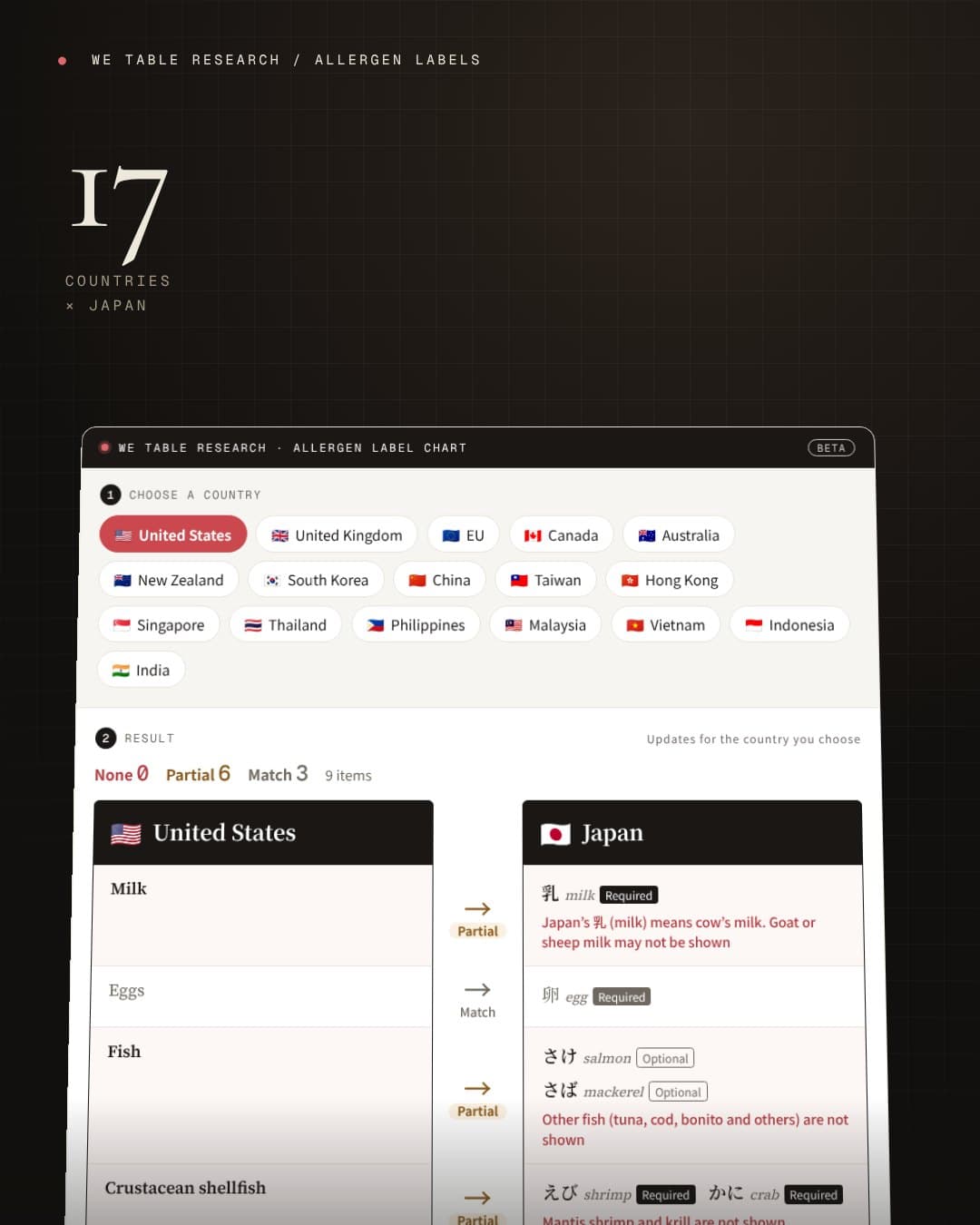
Many restaurants in Japan do not have this step. Japan’s food allergy labeling duty covers packaged, processed food. It does not cover restaurant menus, bento packed when you order, or side dishes sold loose (Japan’s allergen labeling rules). Often the restaurant does not even have the thing to check: a document that lists the allergens in each recipe. Your question can end with the one person in front of you, before it ever reaches the kitchen.
So the “daijoubu desu” you hear is often not the restaurant’s official view. It is that one person’s own feeling or belief. The exception is a restaurant where staff can point to an allergen chart. Where there is nothing to point to, even the friendliest reply is one person’s words. One person’s kindness and the restaurant’s guarantee are different things.
When is the riskiest time to eat out with food allergies in Japan?
There is one more thing I want you to know. Even when the ingredients are right, accidents happen. The cause is the kitchen’s operation: the slips that always happen where people work. The same cutting board. The same tongs. One second in a rush.
In the kitchens I have seen, slips happen most when unusual conditions pile up. When it is busy. When an unplanned order comes in. When several things that break the usual routine happen at the same time.
This is where you can act. Choose a time when the restaurant can run as normal.
- Go right after opening
- Go in the afternoon, after the lunch rush
- Avoid Friday and Saturday nights
Walking in and asking for “gluten free” means dropping the most unusual order into the busiest moment, without warning. Contacting the restaurant in advance and choosing a quiet time is not about being polite to the restaurant. It is about letting the kitchen work as normal, for your own safety.
How to tell a restaurant in Japan about your allergy before you go
The most useful tool is to contact the restaurant 3 to 5 days before your visit.
If the restaurant accepts written contact, I recommend writing. That can be email, a social media DM, a booking form, or messages in a map app.
- You can use translation: write in your own language and add a machine translation in Japanese
- You keep a record: a reply like “We use separate utensils” is with you on the day
- The restaurant can check before it answers: you do not need an instant reply
But many restaurants in Japan do not accept written messages. For many, the phone is the only way to reach them. In that case, calling is fine. When you call, do not ask for an answer on the spot. Ask them to check and call you back. This way you avoid an instant “daijoubu desu.” If a phone call in Japanese is hard for you, you can also ask your hotel concierge.
When you contact them, make these three things clear.
- What you avoid: for example, “wheat, barley and rye” or “egg.” “Gluten free” alone can mean different things at different restaurants (see what “gluten free” means in Japan).
- How strictly you avoid it: Is it enough that it is not in the ingredients? Or do you also need to avoid cross-contact (traces picked up during cooking, from the same oil, pot or utensils)? What about seasonings like soy sauce?
- What you want the restaurant to do: tell you which dishes they can make for you, tell you if they can use separate utensils, tell you if you need to book, and so on.
If it is hard to explain in Japanese, you can use the WE TABLE Food Passport to turn your restrictions into a card in Japanese and show it.
What does the restaurant’s reply tell you?
Contacting the restaurant in advance is a booking request. It is also a way to learn about the kitchen. How detailed the reply is often shows how detailed the kitchen is. But the reply is not a safety verdict. It is a starting point for further questions.
| Type of reply | What you can read from it |
|---|---|
| They ask you questions back (“Is it celiac disease or an allergy?” “How strict?”) | They are trying to understand you as a person. The best sign |
| They answer in detail (“We use separate utensils.” “We can’t serve fried food because the oil is shared.”) | They have a system to separate what they can do from what they can’t |
| Just one line: “Daijoubu desu yo!” (“It’s fine!”) | They may not have understood the question. Be careful if you need to avoid cross-contact |
| No reply, or no call back | They are unlikely to give you individual care in a busy service. You found this out before going |
A short reply, or no reply, can also come from the restaurant’s situation, such as running the kitchen with very few people. How detailed the reply is shows less about the restaurant’s sincerity. It shows more about how far the kitchen’s procedures go right now.
How do you say “I’m allergic” in Japanese?
First, here is how to state your restriction in one line. Put a word from the table below inside the [ ]. You can also find the names Japanese labels use in the Japan allergen list.
| English | Japanese | Reading |
|---|---|---|
| wheat | 小麦 | komugi |
| egg | 卵 | tamago |
| milk / dairy | 乳・乳製品 | nyū / nyūseihin |
| buckwheat | そば | soba |
| peanut | 落花生(ピーナッツ) | rakkasei (pīnattsu) |
| tree nuts | ナッツ類 | nattsu-rui |
| walnut | くるみ | kurumi |
| shrimp / crab | えび・かに | ebi / kani |
| soy | 大豆 | daizu |
| sesame | ごま | goma |
| fish | 魚 | sakana |
To see which other foods to watch with a given allergen, use the food allergy cross-reactivity chart. If you have many restrictions, or you want to explain how strictly you avoid them, it is more reliable to make a Japanese card with Food Passport and show it.
Once you have a booking, arrive on time for the slot you chose. When you sit down, confirm once more in one sentence. That completes your message to the kitchen.
Use the last phrase when you hear “daijoubu desu.” Say it with a smile, so it does not sound like blame. Once you know what they checked, you can see which kind of “daijoubu” it was.
How we approach food allergies at WE TABLE
Japan has no labeling standard for restaurants. So in our view, safety is not something you receive from someone. It is something you and the people in the kitchen build together, each time.
At JOURNEY (our guided dinners, with a course built around your restrictions), we do this work for you. Before your visit, we use a bilingual Japanese–English “food profile” to learn each person’s restrictions: what you avoid, and how strictly. We turn that into a document the kitchen can use. Then we work with the restaurant to separate what it can do from what it cannot. Even so, some kitchens cannot fully separate food. So we show you exactly where we drew the line, and we leave the choice to eat to you and your doctor. We do not say “it is safe.” What we can tell you is what we checked, and how far.
Read next
Questions people ask
What does daijoubu desu mean at a restaurant in Japan?
It means “it’s fine” or “no problem.” It is a kind word that calms your worry, but it does not tell you whether the staff checked with the kitchen. Ask what they checked, or contact the restaurant before your visit.
What should I ask at a restaurant in Japan with no allergen chart?
First ask, “Could you check with the kitchen?” When they come back, ask, “What were you able to check?” Also say exactly what you avoid and how strictly: only as an ingredient, or also the same oil and utensils, and whether soy sauce and other seasonings count. If you can, check by phone or message before your visit.
Should I call or message a restaurant in Japan about my allergy?
If the restaurant accepts messages, a message is better. You can use translation, you keep a record, and the restaurant can check before it answers. Many restaurants in Japan only take phone calls. Then call, and ask them to check and call you back.
How far ahead should I contact a restaurant in Japan about food allergies?
About 3 to 5 days before your visit. This gives the restaurant time to check ingredients and plan, and it is still easy for them to fit into their schedule.
How do you say “I am allergic” in Japanese?
Say “Watashi wa [food] arerugī desu.” For wheat, that is “Watashi wa komugi arerugī desu.” If you have many restrictions, a written card in Japanese is more reliable.
Listen
The key points of this article, as a short video (about 2 min, AI voice).
Sources
- 消費者庁「食物アレルギー表示に関する情報」 (Consumer Affairs Agency: Food allergy labeling)
- U.S. Food and Drug Administration: Food Allergies (scope of FALCPA)
- 厚生労働省「令和6年就業形態の多様化に関する総合実態調査の概況」 (Ministry of Health, Labour and Welfare: Overview of the 2024 General Survey on Diversified Types of Employment)
- 第一ライフ資産運用経済研究所「2025年スポットワーク市場規模の推計」 (Dai-ichi Life group research institute: An estimate of the spot work market size in 2025)
- EUR-Lex: Regulation (EU) No 1169/2011 on the provision of food information to consumers
- 川口良「若者ことばに見る(間)主観化について:『大丈夫』の新用法に注目して」 (Kawaguchi Ryo: (Inter)subjectification in youth language, focusing on new uses of “daijoubu,” Bunkyo University, 2017)
- Daiki Kobayashi, Gluten-Free Japan: Between the Kitchen and the Table (forthcoming)