
Food Allergy Cross-Reactivity Chart for Japan’s 29 Allergens
 Daiki Kobayashi · Founder of WE TABLE
Updated · 10 min read
Reviewed by WE TABLE registered dietitian
This chart is based on research by WE TABLE’s registered dietitian, checked against primary sources such as papers and clinical guides with help from AI (Claude). It is still being updated. Please don’t decide from this page alone: always check with your doctor before you eat. If you spot a mistake or have a question, please contact WE TABLE at any time.
Why we made this chart
A guest with a kiwi allergy once joined WE TABLE JOURNEY. The course had a dish wrapped in banana leaf and steamed. Kiwi and banana are a pair with reported cross-reactivity. So before the dinner, we talked with the chef, who replaced the banana leaf with something else.
When I looked into it later, I could not find any study that tested reactions to banana leaf itself. Even so, we avoid what we cannot confirm. We are now researching the facts behind that kind of decision, one by one. I wanted to turn them into a chart anyone can look up.
1Choose the allergen
Mandatory 9
Recommended 20
2ResultUpdates for the allergen you choose
→ what to watch for if you have this allergy ← things that can lead to a reaction to it ↔ both ways. Open a row for figures, cooking and sources.
HighUsually avoided together, or a high share react to bothModerateA notable share of people reactVariesDepends strongly on the person, the protein or the cooking; decide case by case
If you are allergic to Shrimp, also watch for 2
↔Crab, lobster (other crustaceans)High
Figures: Japanese guidance: 65% of shrimp-allergic patients also react to crab (shrimp to crab direction). Japanese study (2006, 99 shrimp-allergic patients): 64.7% of the 68 who had eaten crab also reacted to crab (likely the basis of the guidance's 65%). US rough guide (AAAAI handout): about 75% risk of reacting to another crustacean.
Cooking: Tropomyosin is heat stable; cooked shellfish still causes reactions.
Crustaceans cross-react strongly. In Japan shrimp and crab are mandatory label items. Steam from cooking can also cause reactions. Tolerance of extracts in seasonings, soups and shrimp crackers varies from person to person.
←House dust mite, cockroach (inhaled)Not a foodVaries
Tropomyosin is shared. People sensitized to dust mites often test positive to shrimp without symptoms (false positives). Dust mite sensitization has also been reported as a cause of real shrimp and snail allergy. A children's study in southern China (2018) suggested that more frequent shrimp sensitization in rural areas was explained by cross-reactivity with cockroach (mostly via proteins other than tropomyosin). This is about sensitization, not the share with symptoms.
If you are allergic to Crab, also watch for 2
↔ShrimpHigh
Figures: Japanese guidance: 65% of shrimp-allergic patients also react to crab (shrimp to crab direction). Japanese study (2006, 99 shrimp-allergic patients): 64.7% of the 68 who had eaten crab also reacted to crab (likely the basis of the guidance's 65%). US rough guide (AAAAI handout): about 75% risk of reacting to another crustacean.
Cooking: Tropomyosin is heat stable; cooked shellfish still causes reactions.
Crustaceans cross-react strongly. In Japan shrimp and crab are mandatory label items. Steam from cooking can also cause reactions. Tolerance of extracts in seasonings, soups and shrimp crackers varies from person to person.
←House dust mite, cockroach (inhaled)Not a foodVaries
Tropomyosin is shared. People sensitized to dust mites often test positive to shrimp without symptoms (false positives). Dust mite sensitization has also been reported as a cause of real shrimp and snail allergy. A children's study in southern China (2018) suggested that more frequent shrimp sensitization in rural areas was explained by cross-reactivity with cockroach (mostly via proteins other than tropomyosin). This is about sensitization, not the share with symptoms.
If you are allergic to Walnut, also watch for 6
↔PecanHigh
Figures: European children's food-challenge study (Brough 2020): 75% of walnut-allergic children also reacted to pecan; 97% of pecan-allergic children also reacted to walnut. The figures differ by direction. Other studies report a range.
Same plant family. If allergic to one, avoiding both is the standard advice.
→Other tree nuts (different families)Varies
Figures: Brough 2020 (3 European centers, 122 children with a nut or sesame allergy): 60.7% were allergic to two or more of peanut, tree nuts and sesame. This is from specialist clinics and does not apply directly to everyone. Other studies report lower rates.
Japanese guidance: tree nuts do not need to be avoided as one group; check each one. But many people are allergic to more than one. When eating out, watch for cross-contact through shared tools and oil.
←PeanutVaries
Figures: Australian population cohort (2019, 5,276 children): 27% of children with peanut allergy only at age 1 had challenge-confirmed tree nut allergy at age 6 (37% if allergic to both peanut and egg). Studies using food challenges report co-allergy in 12-38% (review 2021).
Cooking: Roasting increases peanut allergenicity.
Peanut is a legume, botanically unrelated to tree nuts. They need not be avoided together (Japanese guidance). But many people are allergic to both. This is usually co-allergy (separate sensitization), not botanical cross-reactivity.
←MacadamiaVaries
A European children's challenge study (2020) found a walnut-pecan-hazelnut-macadamia cluster of allergies that tend to occur together (no percentage in the abstract). A Japanese children's study (2021) examined macadamia cross-reactivity with walnut and hazelnut. An Australian report (1999) found only partial cross-reactivity with hazelnut. Macadamia is from a different plant family, so each nut is checked individually. In Japan macadamia is a recommended label item.
←Peach (LTP sensitization)Varies
Figures: Italian study (2002, 20 people with rose-family fruit allergy sensitized only to LTP): 80% had reactions to tree nuts and 40% to peanut.
Cooking: LTP resists heat and digestion; cooked or roasted foods can still cause reactions.
Part of LTP syndrome. This is from a Mediterranean study; in Japan many severe peach reactions involve GRP instead. When the type of peach allergy is unknown, ask the doctor about nuts as well.
If you are allergic to Wheat, also watch for 1
If you are allergic to Buckwheat, also watch for 1
→Noodles boiled in the same water (udon and others)High
Cooking: Heat does not reliably reduce allergenicity.
This is cross-contact, not cross-reactivity. Buckwheat allergen dissolves in water and survives heat, so never share boiling water or pots. Inhaling buckwheat husk or flour can cause asthma-like symptoms. Reactions are often severe; deaths have been reported.
If you are allergic to Egg, also watch for 2
→Quail, duck and other birds' eggsHigh
Cooking: Cooking lowers egg allergenicity (ovomucoid is relatively heat stable). Someone who tolerates well-cooked egg may still react to raw or soft-cooked egg.
Japanese guidance: with hen's egg allergy, avoid other birds' eggs too. Quail egg is included in Japan's 'egg' label category. Rarely, someone tolerates hen's egg but reacts to quail or duck egg.
←Bird feathers and droppings (long-term bird keeping)Not a foodVaries
Bird-egg syndrome mainly affects adults. Inhaled bird serum albumin (Gal d 5) causes sensitization, then egg yolk or chicken causes symptoms. This is different from the usual egg white allergy in children.
Sources: 1
If you are allergic to Milk, also watch for 2
→Goat and sheep milkHigh
Figures: Spanish pediatric allergy society position paper (2015): up to 92% of people with cow's milk allergy do not tolerate goat's milk.
Strong cross-reaction with cow's milk; not a substitute (Japanese guidance). Goat and sheep milk are outside Japan's 'milk' label category, so they may not be labeled (for example goat cheese).
←Alpha-gal syndromeNot a foodVaries
Some people react to gelatin (pork or beef), marshmallows and gummies. Dairy also contains alpha-gal, but many people tolerate it; if symptoms continue, dairy may also be removed. Gelatin-containing medicines and vaccines also need attention.
Sources: 1
If you are allergic to Peanut, also watch for 5
→LupinModerate
Figures: Small study in Chile (2023): 44% of peanut-allergic participants reacted to lupin in a food challenge (peanut to lupin direction). The study was small.
Lupin flour is used in bread, pasta and gluten-free foods in Europe, where labeling is required. It is not a labeled allergen in Japan. Reactions are often reported in people with peanut allergy.
→Tree nutsVaries
Figures: Australian population cohort (2019, 5,276 children): 27% of children with peanut allergy only at age 1 had challenge-confirmed tree nut allergy at age 6 (37% if allergic to both peanut and egg). Studies using food challenges report co-allergy in 12-38% (review 2021).
Cooking: Roasting increases peanut allergenicity.
Peanut is a legume, botanically unrelated to tree nuts. They need not be avoided together (Japanese guidance). But many people are allergic to both. This is usually co-allergy (separate sensitization), not botanical cross-reactivity.
←Pea, lentil, lupin, beansModerate
Figures: Dutch study (2023, 9-30 people per group): among people allergic to pea, lupin, lentil or beans, 64.7-77.8% were also allergic to peanut (this direction). The reverse (peanut to other legumes) was 16.7% or less. Groups were small.
The figure depends strongly on direction. People allergic to a legume other than peanut quite often also have peanut allergy.
Sources: 1
←Peach (LTP sensitization)Varies
Figures: Italian study (2002, 20 people with rose-family fruit allergy sensitized only to LTP): 80% had reactions to tree nuts and 40% to peanut.
Cooking: LTP resists heat and digestion; cooked or roasted foods can still cause reactions.
Part of LTP syndrome. This is from a Mediterranean study; in Japan many severe peach reactions involve GRP instead. When the type of peach allergy is unknown, ask the doctor about nuts as well.
←Alder and birch (Betulaceae)Varies
Cooking: PR-10 breaks down with heat, so cooked or processed food is often tolerated. Severe reactions are reported after large amounts of lightly processed foods such as soy milk.
Season in Japan: Alder mostly January-April (wetlands, including Kanto). Birch mostly April-June; common even in lowland Hokkaido, but elsewhere limited to high altitudes.
If you are allergic to Cashew, also watch for 4
↔PistachioHigh
Figures: Same study (Brough 2020): 83% of cashew-allergic children also reacted to pistachio; 97% of pistachio-allergic children also reacted to cashew. Other studies report a wider range for cashew to pistachio.
Same plant family. If allergic to one, avoiding both is the standard advice. In Japan, cashew labeling became mandatory in 2026 (with a transition period); pistachio is a recommended item. Figures vary greatly by direction and study. In a Dutch children's study (2017), of 29 children sensitized to both cashew and pistachio, 34% reacted in a pistachio challenge (31% of cashew-challenge-positive children). Dutch and Australian studies together report 31–36% of cashew-allergic children reacting to pistachio (review 2021). Japan's guidance still advises avoiding both, but not everyone with one of these allergies reacts to both.
→Other tree nuts (different families)Varies
Figures: Brough 2020 (3 European centers, 122 children with a nut or sesame allergy): 60.7% were allergic to two or more of peanut, tree nuts and sesame. This is from specialist clinics and does not apply directly to everyone. Other studies report lower rates.
Japanese guidance: tree nuts do not need to be avoided as one group; check each one. But many people are allergic to more than one. When eating out, watch for cross-contact through shared tools and oil.
←PeanutVaries
Figures: Australian population cohort (2019, 5,276 children): 27% of children with peanut allergy only at age 1 had challenge-confirmed tree nut allergy at age 6 (37% if allergic to both peanut and egg). Studies using food challenges report co-allergy in 12-38% (review 2021).
Cooking: Roasting increases peanut allergenicity.
Peanut is a legume, botanically unrelated to tree nuts. They need not be avoided together (Japanese guidance). But many people are allergic to both. This is usually co-allergy (separate sensitization), not botanical cross-reactivity.
←Peach (LTP sensitization)Varies
Figures: Italian study (2002, 20 people with rose-family fruit allergy sensitized only to LTP): 80% had reactions to tree nuts and 40% to peanut.
Cooking: LTP resists heat and digestion; cooked or roasted foods can still cause reactions.
Part of LTP syndrome. This is from a Mediterranean study; in Japan many severe peach reactions involve GRP instead. When the type of peach allergy is unknown, ask the doctor about nuts as well.
If you are allergic to Almond, also watch for 4
→Other tree nuts (different families)Varies
Figures: Brough 2020 (3 European centers, 122 children with a nut or sesame allergy): 60.7% were allergic to two or more of peanut, tree nuts and sesame. This is from specialist clinics and does not apply directly to everyone. Other studies report lower rates.
Japanese guidance: tree nuts do not need to be avoided as one group; check each one. But many people are allergic to more than one. When eating out, watch for cross-contact through shared tools and oil.
←PeanutVaries
Figures: Australian population cohort (2019, 5,276 children): 27% of children with peanut allergy only at age 1 had challenge-confirmed tree nut allergy at age 6 (37% if allergic to both peanut and egg). Studies using food challenges report co-allergy in 12-38% (review 2021).
Cooking: Roasting increases peanut allergenicity.
Peanut is a legume, botanically unrelated to tree nuts. They need not be avoided together (Japanese guidance). But many people are allergic to both. This is usually co-allergy (separate sensitization), not botanical cross-reactivity.
←Peach (LTP sensitization)Varies
Figures: Italian study (2002, 20 people with rose-family fruit allergy sensitized only to LTP): 80% had reactions to tree nuts and 40% to peanut.
Cooking: LTP resists heat and digestion; cooked or roasted foods can still cause reactions.
Part of LTP syndrome. This is from a Mediterranean study; in Japan many severe peach reactions involve GRP instead. When the type of peach allergy is unknown, ask the doctor about nuts as well.
←Alder and birch (Betulaceae)Varies
Cooking: PR-10 breaks down with heat, so cooked or processed food is often tolerated. Severe reactions are reported after large amounts of lightly processed foods such as soy milk.
Season in Japan: Alder mostly January-April (wetlands, including Kanto). Birch mostly April-June; common even in lowland Hokkaido, but elsewhere limited to high altitudes.
If you are allergic to Abalone, also watch for 2
→Other mollusks (sea snails, clams, oysters), squid, octopusVaries
Cooking: Tropomyosin is heat stable; cooked abalone can still cause reactions.
Abalone's main allergen is tropomyosin (Hal m 1). Tropomyosin cross-reacts among mollusks, and an overseas review suggests people with mollusk allergy consider avoiding other mollusks. Japanese guidance says bivalves cross-react with each other, but crustaceans, cephalopods and shellfish need not be avoided as one group. A child with food-dependent exercise-induced anaphylaxis from abalone has been reported (2022). In Japan abalone is a recommended label item; other shellfish are not.
←House dust mite, cockroach (inhaled)Not a foodVaries
Tropomyosin is shared. People sensitized to dust mites often test positive to shrimp without symptoms (false positives). Dust mite sensitization has also been reported as a cause of real shrimp and snail allergy. A children's study in southern China (2018) suggested that more frequent shrimp sensitization in rural areas was explained by cross-reactivity with cockroach (mostly via proteins other than tropomyosin). This is about sensitization, not the share with symptoms.
If you are allergic to Squid, also watch for 3
→Octopus (other cephalopods)Varies
Cooking: Tropomyosin is heat stable; cooked squid can still cause reactions.
Japanese guidance says mollusks such as squid and octopus share cross-reactive proteins, and a Japanese analysis of children's blood tests grouped octopus with squid. A small Spanish study (1992, 7 patients) found no blood-test cross-reaction between squid and octopus. It varies, so check individually. In Japan squid is a recommended label item; octopus is not covered.
←AbaloneVaries
Cooking: Tropomyosin is heat stable; cooked abalone can still cause reactions.
Abalone's main allergen is tropomyosin (Hal m 1). Tropomyosin cross-reacts among mollusks, and an overseas review suggests people with mollusk allergy consider avoiding other mollusks. Japanese guidance says bivalves cross-react with each other, but crustaceans, cephalopods and shellfish need not be avoided as one group. A child with food-dependent exercise-induced anaphylaxis from abalone has been reported (2022). In Japan abalone is a recommended label item; other shellfish are not.
←House dust mite (inhaled sensitization)Not a foodVaries
In an Italian study (1996, 28 patients), everyone who had asthma attacks after eating snails was allergic to dust mites, and mites were thought to be the sensitizer. Snail anaphylaxis during mite immunotherapy has also been reported. People with mite allergy often test positive to snails, shellfish and crustaceans, but a positive test does not mean they will react.
If you are allergic to Salmon roe, also watch for 1
→Other roe (pollock roe, herring roe, flying fish roe and others)Varies
If you are allergic to Orange, also watch for 3
→Other citrus (lemon, mandarin, grapefruit and others)Varies
Cooking: GRP (Cit s 7) and LTP (Cit s 3) are heat stable; profilin (Cit s 2) weakens with heat.
Main orange allergens are a germin-like protein (Cit s 1), profilin (Cit s 2), LTP (Cit s 3) and GRP (Cit s 7). A small Spanish study (2025, 5 patients) found the same type of protein (Cit s 1) in lemon and mandarin peel, and all patients' IgE bound it. No study was found giving the clinical cross-reaction rate between citrus fruits. In Japan orange is a recommended label item (mandarin and lemon are not covered).
←Cedar and cypress pollen (GRP)Not a foodVaries
←Grass and weed pollenNot a foodVaries
Figures: Italian study (2013): 39% of people with pollen allergy were sensitized to citrus (sensitization, not the share with symptoms).
Cooking: If profilin is the cause, cooked or processed forms are often tolerated.
Japan's pollen-food table links grass and weed pollen (grass, ragweed, mugwort) with orange via profilin. Cedar and cypress pollen may be linked via GRP (separate entry). For mouth symptoms, skin tests with fresh orange were more sensitive than commercial extracts (Italy, 1989).
If you are allergic to Kiwifruit, also watch for 5
↔Banana, latexIncludes non-foodVaries
↔BananaVaries
These are part of latex-fruit syndrome. A Swiss case series (2002) found some banana-allergic people also sensitized to latex, avocado and kiwi, and others not sensitized to latex. Banana allergens include profilin (Mus a 1), chitinase (Mus a 2) and LTP (Mus a 3), and the spread to other foods depends on which one is involved. In Japan banana is a recommended label item.
→Cooked or processed kiwi (jam, baked goods)Varies
Figures: European multicenter study (2013, 311 people): sensitization to Act d 1 (actinidin) was independently linked to severe kiwi allergy (odds ratio 3.98); in Iceland Act d 1 was the main allergen (32%). Spanish challenge study (2004): 46% of kiwi-allergic patients had systemic symptoms, and all of those without pollen allergy did.
Cooking: Test-tube study (2008): in processed foods, IgE binding to Act d 2 remained while Act d 1 was not detected. PR-10 (Act d 8) breaks down with heat. Whether cooked kiwi is tolerated depends on the protein.
Kiwi allergy includes a pollen-related type with mostly mouth symptoms, and a type sensitized directly to kiwi with more severe reactions. Japanese guidance notes a type in which tiny amounts of kiwi, banana, peach or apple cause anaphylaxis, unrelated to pollen. Severe reactions are reported to be more common in children than adults. In Japan kiwifruit is a recommended label item.
←Latex (natural rubber)Not a foodVaries
Figures: Literature review (2024): the share of latex-allergic people who also react to fruit ranged from 4% to 88% across studies (30-50% is often quoted). Banana, avocado, kiwi and papaya were most common.
Latex-fruit syndrome. Many cases involve anaphylaxis, not just mouth symptoms. Papaya, peach, tomato and others have also been reported. In kitchens using rubber gloves, check the glove material.
←Birch and alder pollen (Betulaceae)Not a foodVaries
Figures: Hokkaido clinic study (2015): 37% of 167 birch-allergic patients with oral allergy syndrome reacted to kiwi. European multicenter study (2013, 311 kiwi-allergic patients): 58% in western/central and 44% in eastern Europe were sensitized to Act d 8 (PR-10).
Cooking: Act d 8 (PR-10) breaks down with heat.
Pollen-related kiwi allergy mostly causes mouth symptoms. A type sensitized directly to kiwi (Act d 1), unrelated to pollen, is more often severe (separate entry). Kiwi was a common trigger of mouth symptoms even in Fukui, where birch does not grow.
If you are allergic to Beef, also watch for 1
←Tick bites (alpha-gal)Not a foodVaries
If you are allergic to Sesame, also watch for 0
No established cross-reactivity is listed here. Co-allergy with nuts (being allergic to both) has been reported.
If you are allergic to Salmon, also watch for 4
→Other fishVaries
Cooking: Parvalbumin is heat stable; cooked fish can still cause reactions.
Fish cross-react, but not everyone needs to avoid all fish. Japanese guidance recommends testing to find which fish the person can eat. Avoiding fish by color (oily, red or white fish) has no scientific basis. Bonito and dried sardine stock often do not need to be avoided. Some people react only to particular species.
→Canned tuna and salmonVaries
Figures: 1992 US study: none of 18 fish-allergic patients reacted to canned tuna in challenges. 2023 study: in 66% of 53 fish-allergic patients, IgE bound to canned fish proteins (sardine 51%, salmon 43-45%, tuna 8-17%).
Cooking: Canning greatly reduces parvalbumin, but what remains, and collagen, can still react.
Canning (high heat and pressure) reduces allergens, and some fish-allergic people tolerate canned fish. But some heat-stable allergens remain, so canned fish is not tolerated by everyone with fish allergy. Do not offer it without a doctor's assessment.
→Fish gelatin and collagenVaries
Figures: Danish challenge study (2004): none of 30 fish-allergic people reacted to fish gelatin (cumulative 3.61 g). Japanese study (2000): 3 of 10 fish-allergic patients had IgE to fish gelatin. Hong Kong and Japan study (2023, 103 fish-allergic people): 38.9% were sensitized to collagen (74.7% to parvalbumin).
Fish gelatin (collagen) is reported as an important allergen in Japanese patients, while another study found no reactions at amounts used in food. Because it varies, tell fish-allergic people in advance when fish gelatin or collagen (including supplements and cosmetics) is used.
←MackerelVaries
Figures: European measurement study (2010): parvalbumin was 0.3-0.7 mg in mackerel, 1-2.5 mg in salmon and cod, over 2.5 mg in herring and others, and under 0.05 mg in tuna (per gram of raw flesh). Japanese study (2016): content varied widely across 22 species; large migratory fish such as salmon, swordfish and tuna were low, and dark muscle was lower than white muscle. Yet in a Japanese survey, 88% could not eat other fish as well as mackerel and salmon.
Cooking: Parvalbumin is heat stable; cooked fish can still cause reactions.
People can react even to low-parvalbumin fish; do not decide which fish are tolerated from content alone. After symptoms from mackerel, Anisakis allergy and histamine poisoning need to be ruled out (Japanese guidance). In Japan mackerel is a recommended label item.
If you are allergic to Mackerel, also watch for 4
→Other fishVaries
Cooking: Parvalbumin is heat stable; cooked fish can still cause reactions.
Fish cross-react, but not everyone needs to avoid all fish. Japanese guidance recommends testing to find which fish the person can eat. Avoiding fish by color (oily, red or white fish) has no scientific basis. Bonito and dried sardine stock often do not need to be avoided. Some people react only to particular species.
→Canned tuna and salmonVaries
Figures: 1992 US study: none of 18 fish-allergic patients reacted to canned tuna in challenges. 2023 study: in 66% of 53 fish-allergic patients, IgE bound to canned fish proteins (sardine 51%, salmon 43-45%, tuna 8-17%).
Cooking: Canning greatly reduces parvalbumin, but what remains, and collagen, can still react.
Canning (high heat and pressure) reduces allergens, and some fish-allergic people tolerate canned fish. But some heat-stable allergens remain, so canned fish is not tolerated by everyone with fish allergy. Do not offer it without a doctor's assessment.
→Fish gelatin and collagenVaries
Figures: Danish challenge study (2004): none of 30 fish-allergic people reacted to fish gelatin (cumulative 3.61 g). Japanese study (2000): 3 of 10 fish-allergic patients had IgE to fish gelatin. Hong Kong and Japan study (2023, 103 fish-allergic people): 38.9% were sensitized to collagen (74.7% to parvalbumin).
Fish gelatin (collagen) is reported as an important allergen in Japanese patients, while another study found no reactions at amounts used in food. Because it varies, tell fish-allergic people in advance when fish gelatin or collagen (including supplements and cosmetics) is used.
←SalmonVaries
Figures: Japanese survey (2016): 88% of fish-allergic respondents could not eat other fish as well as mackerel and salmon. Nordic challenge study (2017, 35 fish-allergic patients; cod, salmon, mackerel): about one third tolerated at least one species. US rough guide (AAAAI handout): about 50% risk of reacting to another fish.
Cooking: Parvalbumin is heat stable, but one study measured 20-60% less in cooked or commercial products. Baking and frying kept more heat-sensitive allergens than steaming or boiling (salmon study).
Salmon flesh was measured at 1-2.5 mg parvalbumin per gram, similar to cod and more than tuna. Japanese patients often reacted to heat-sensitive salmon proteins such as collagen. Salmon roe has a different main allergen. Which fish a person tolerates varies and is decided with a doctor (for example by food challenge).
If you are allergic to Soy, also watch for 1
←Birch and alder pollen (Betulaceae)Not a foodVaries
Figures: Hokkaido clinic study (2015): 10% (16) of 167 birch-allergic patients with oral allergy syndrome reacted to soy milk. Swiss study (2004): of 94 birch-allergic patients strongly sensitized to Bet v 1, 71% were sensitized to Gly m 4 and 9.6% reported soy allergy; in challenges 6 of 16 had reactions beyond the mouth.
Cooking: Gly m 4 content depends strongly on processing (0-70 ppm). Soy milk is lightly processed and drunk quickly in large amounts, which is thought to explain more severe reactions. Consider it separately from heavily fermented or heated foods such as soy sauce and miso.
Pollen-related reactions to soy milk can go beyond the mouth, for example a burning feeling in the chest or stomach. Standard soy blood tests are often negative or low; a Gly m 4 test (covered by insurance in Japan) helps.
If you are allergic to Chicken, also watch for 1
←Bird feathers and droppings (long-term bird keeping)Not a foodVaries
Bird-egg syndrome mainly affects adults. Inhaled bird serum albumin (Gal d 5) causes sensitization, then egg yolk or chicken causes symptoms. This is different from the usual egg white allergy in children.
Sources: 1
If you are allergic to Banana, also watch for 7
↔Avocado, chestnut, kiwi (latex-related fruit)Includes non-foodVaries
These are part of latex-fruit syndrome. A Swiss case series (2002) found some banana-allergic people also sensitized to latex, avocado and kiwi, and others not sensitized to latex. Banana allergens include profilin (Mus a 1), chitinase (Mus a 2) and LTP (Mus a 3), and the spread to other foods depends on which one is involved. In Japan banana is a recommended label item.
→Melon, watermelon (gourd family)Varies
Cooking: If profilin is the cause, cooked or processed forms are often tolerated.
Through profilin from weed and grass pollen, mouth symptoms from banana and from the gourd family (melon, watermelon, cucumber) can occur together. Profilin causes symptoms only in some people (Japanese guidance).
→Banana leaf (wrapping for steaming)Not established
←Latex (natural rubber)Not a foodVaries
Figures: Literature review (2024): the share of latex-allergic people who also react to fruit ranged from 4% to 88% across studies (30-50% is often quoted). Banana, avocado, kiwi and papaya were most common.
Latex-fruit syndrome. Many cases involve anaphylaxis, not just mouth symptoms. Papaya, peach, tomato and others have also been reported. In kitchens using rubber gloves, check the glove material.
←Weed and grass pollen (ragweed, grasses and others)Not a foodVaries
Figures: German study (2002): IgE bound banana profilin in 7 of 16 (44%) people with suspected banana reactions.
Cooking: If profilin is the cause, cooked or processed forms are often tolerated.
Japan's pollen-food table links weed and grass pollen (grasses, ragweed, mugwort and others) with banana via profilin. The link between ragweed allergy and melon and banana has been reported since 1970 and is known as the ragweed-melon-banana association (plantain weed pollen is reported with melon).
If you are allergic to Pistachio, also watch for 4
↔CashewHigh
Figures: Same study (Brough 2020): 83% of cashew-allergic children also reacted to pistachio; 97% of pistachio-allergic children also reacted to cashew. Other studies report a wider range for cashew to pistachio.
Same plant family. If allergic to one, avoiding both is the standard advice. In Japan, cashew labeling became mandatory in 2026 (with a transition period); pistachio is a recommended item. Figures vary greatly by direction and study. In a Dutch children's study (2017), of 29 children sensitized to both cashew and pistachio, 34% reacted in a pistachio challenge (31% of cashew-challenge-positive children). Dutch and Australian studies together report 31–36% of cashew-allergic children reacting to pistachio (review 2021). Japan's guidance still advises avoiding both, but not everyone with one of these allergies reacts to both.
→Other tree nuts (different families)Varies
Figures: Brough 2020 (3 European centers, 122 children with a nut or sesame allergy): 60.7% were allergic to two or more of peanut, tree nuts and sesame. This is from specialist clinics and does not apply directly to everyone. Other studies report lower rates.
Japanese guidance: tree nuts do not need to be avoided as one group; check each one. But many people are allergic to more than one. When eating out, watch for cross-contact through shared tools and oil.
←PeanutVaries
Figures: Australian population cohort (2019, 5,276 children): 27% of children with peanut allergy only at age 1 had challenge-confirmed tree nut allergy at age 6 (37% if allergic to both peanut and egg). Studies using food challenges report co-allergy in 12-38% (review 2021).
Cooking: Roasting increases peanut allergenicity.
Peanut is a legume, botanically unrelated to tree nuts. They need not be avoided together (Japanese guidance). But many people are allergic to both. This is usually co-allergy (separate sensitization), not botanical cross-reactivity.
←Peach (LTP sensitization)Varies
Figures: Italian study (2002, 20 people with rose-family fruit allergy sensitized only to LTP): 80% had reactions to tree nuts and 40% to peanut.
Cooking: LTP resists heat and digestion; cooked or roasted foods can still cause reactions.
Part of LTP syndrome. This is from a Mediterranean study; in Japan many severe peach reactions involve GRP instead. When the type of peach allergy is unknown, ask the doctor about nuts as well.
If you are allergic to Pork, also watch for 2
←Tick bites (alpha-gal)Not a foodVaries
←Cat (dander)Not a foodVaries
Cooking: Albumin is heat sensitive; heating has weakened reactions in reports. Take care with raw, undercooked or dried meat.
Pork-cat syndrome. Inhaled cat serum albumin (Fel d 2) causes sensitization, then pork (Sus s 1), beef, lamb and other meat cause symptoms. One reported Japanese child also reacted to cow's milk. See syndromes.
If you are allergic to Macadamia, also watch for 4
→Other tree nuts (different families)Varies
Figures: Brough 2020 (3 European centers, 122 children with a nut or sesame allergy): 60.7% were allergic to two or more of peanut, tree nuts and sesame. This is from specialist clinics and does not apply directly to everyone. Other studies report lower rates.
Japanese guidance: tree nuts do not need to be avoided as one group; check each one. But many people are allergic to more than one. When eating out, watch for cross-contact through shared tools and oil.
→Walnut, pecan, hazelnutVaries
A European children's challenge study (2020) found a walnut-pecan-hazelnut-macadamia cluster of allergies that tend to occur together (no percentage in the abstract). A Japanese children's study (2021) examined macadamia cross-reactivity with walnut and hazelnut. An Australian report (1999) found only partial cross-reactivity with hazelnut. Macadamia is from a different plant family, so each nut is checked individually. In Japan macadamia is a recommended label item.
←PeanutVaries
Figures: Australian population cohort (2019, 5,276 children): 27% of children with peanut allergy only at age 1 had challenge-confirmed tree nut allergy at age 6 (37% if allergic to both peanut and egg). Studies using food challenges report co-allergy in 12-38% (review 2021).
Cooking: Roasting increases peanut allergenicity.
Peanut is a legume, botanically unrelated to tree nuts. They need not be avoided together (Japanese guidance). But many people are allergic to both. This is usually co-allergy (separate sensitization), not botanical cross-reactivity.
←Peach (LTP sensitization)Varies
Figures: Italian study (2002, 20 people with rose-family fruit allergy sensitized only to LTP): 80% had reactions to tree nuts and 40% to peanut.
Cooking: LTP resists heat and digestion; cooked or roasted foods can still cause reactions.
Part of LTP syndrome. This is from a Mediterranean study; in Japan many severe peach reactions involve GRP instead. When the type of peach allergy is unknown, ask the doctor about nuts as well.
If you are allergic to Peach, also watch for 5
→Other fruit, nuts and vegetables (apple, nuts, tomato and others)Varies
Cooking: LTP resists heat and digestion; cooked and processed foods (including juice, jam and canned fruit) can still cause reactions.
LTP syndrome. Peach Pru p 3 is often the first sensitizer, and reactions may spread to many plant foods. Exercise, alcohol and painkillers can make reactions worse. Most common in the Mediterranean.
→Tree nuts and peanutVaries
Figures: Italian study (2002, 20 people with rose-family fruit allergy sensitized only to LTP): 80% had reactions to tree nuts and 40% to peanut.
Cooking: LTP resists heat and digestion; cooked or roasted foods can still cause reactions.
Part of LTP syndrome. This is from a Mediterranean study; in Japan many severe peach reactions involve GRP instead. When the type of peach allergy is unknown, ask the doctor about nuts as well.
←Cedar and cypress pollen (GRP)Not a foodVaries
←Birch and alder pollen (Betulaceae)Not a foodVaries
Figures: Hokkaido clinic study (2015): 67% of 167 birch-allergic patients with oral allergy syndrome reacted to peach. Fukui study (2020): 78.8% of 52 patients with peach-related mouth symptoms were positive to Pru p 1 (PR-10).
Cooking: If PR-10 is the cause, cooked or processed peach is often tolerated. If GRP (Pru p 7) or LTP (Pru p 3) is the cause, cooked peach may still cause reactions.
Peach allergy has three main types: PR-10 (pollen-related, mostly mouth symptoms), GRP (common in Japan, severe symptoms such as eyelid swelling) and LTP (common in the Mediterranean, systemic reactions). The same 'peach allergy' may need different handling. In Japan peach is a recommended label item.
←AppleVaries
Figures: Hokkaido clinic study (2015): among birch-allergic patients with oral allergy syndrome, 74% reacted to apple, 67% to peach, 55% to cherry and 37% to pear (many react to several fruits).
Cooking: PR-10 type often weakens with heat. LTP type can react even to cooked or processed fruit.
Japan's pollen-food table groups rose-family fruit (apple, cherry, peach, pear, loquat and others) with birch-family pollen (PR-10). How far it spreads to other fruit, and how severe it is, depends on the protein type.
If you are allergic to Yam (yamaimo), also watch for 1
→Cooked yam (grilled, fried snacks and other processed foods)Varies
Cooking: Japanese children's study (2005): 7 children with yam IgE and immediate reactions also reacted to cooked or processed yam (yam snacks, grilled yam). Chinese cases (2018): 3 cases of anaphylaxis from boiled yam; a heat-stable protein, dioscorin (DB3S), was thought responsible.
IgE-mediated yam allergy is rare, but can cause breathing and stomach symptoms as well as skin symptoms. Cooking may not make it tolerable. No study was found showing cross-reactivity with other tubers (such as taro) or latex. In Japan yam is a recommended label item. Some Kampo (herbal) medicines contain yam (Japanese guidance).
If you are allergic to Apple, also watch for 5
→Other rose-family fruit (pear, peach, cherry, loquat, strawberry and others)Varies
Figures: Hokkaido clinic study (2015): among birch-allergic patients with oral allergy syndrome, 74% reacted to apple, 67% to peach, 55% to cherry and 37% to pear (many react to several fruits).
Cooking: PR-10 type often weakens with heat. LTP type can react even to cooked or processed fruit.
Japan's pollen-food table groups rose-family fruit (apple, cherry, peach, pear, loquat and others) with birch-family pollen (PR-10). How far it spreads to other fruit, and how severe it is, depends on the protein type.
→Cooked or processed apple, peeled apple, different varietiesVaries
Figures: Study in 4 European countries (2006, 389 people with apple allergy): in the Netherlands, Austria and Italy over 90% had mouth symptoms only, linked to Mal d 1 (PR-10). In Spain over 35% had systemic reactions, linked to Mal d 3 (LTP; odds ratio for systemic reactions 7.76). Dutch challenge study (2005): varieties differed in allergenicity (a significant difference between Golden Delicious and Santana).
Cooking: PR-10 type weakens easily with heat. A review (2021) says choosing varieties, peeling and heating may lower the risk of severe reactions. LTP is concentrated in the peel and is heat stable.
Cooking, peeling and variety mainly matter for the PR-10 type; they may not help with LTP or GRP types. Do not generalize that a certain variety is fine.
←Peach (LTP sensitization)Varies
Cooking: LTP resists heat and digestion; cooked and processed foods (including juice, jam and canned fruit) can still cause reactions.
LTP syndrome. Peach Pru p 3 is often the first sensitizer, and reactions may spread to many plant foods. Exercise, alcohol and painkillers can make reactions worse. Most common in the Mediterranean.
←Birch and alder pollen (Betulaceae)Not a foodVaries
Figures: Hokkaido resident survey (2026, 3,615 people): 66.55% of people with physician-diagnosed birch pollen allergy had mouth symptoms from some food (not only apple). Hokkaido clinic study (2015): among 167 birch-allergic patients with oral allergy syndrome, triggers were apple 74%, peach 67%, cherry 55%, pear 37% and kiwi 37%. Fukui study in a birch-free area (2020): 82.4% of 34 patients with apple-related mouth symptoms were positive to Mal d 1 (PR-10).
Cooking: Mal d 1 (PR-10) breaks down with heat, so cooked or processed apple (jam, baked apple) is often tolerated. Peeling and choice of variety have also been reported to reduce reactions.
In Japan, sensitization to alder pollen was strongly linked to mouth symptoms from apple and peach (Japanese study, including Kanto). Symptoms can be stronger in pollen season. In the Mediterranean, severe apple allergy due to LTP (Mal d 3) is common and is a different type.
←Japanese cedar and cypress (Cupressaceae)Not a foodVaries
Cooking: Tomato: not enough data. GRP fruit: heat stable; cooked or processed forms may still cause reactions.
Season in Japan: Mainly spring: cedar mostly February-April, cypress mostly March-May (cypress can exceed cedar west of Kanto in some years). Small amounts in autumn. Varies by region.
If you are allergic to Gelatin, also watch for 5
→Medicines containing gelatin (suppositories, capsules, Kampo medicines and others)High
Japan's guidance lists a gelatin-containing suppository (Escre) as contraindicated for people with gelatin allergy, and notes that some Kampo medicines contain gelatin. In Japan in 1996-97, 10 children had systemic reactions (5 with anaphylaxis) to a gelatin-containing sedative suppository, and all had gelatin IgE. In alpha-gal syndrome, some people also need care with gelatin-based medicines and products.
→Gelatin from other mammalsVaries
Japanese study (1999, 10 children with anaphylaxis to vaccines containing bovine gelatin): IgE in most children also bound kangaroo and mouse gelatin (blood-test cross-reaction). Gelatins from mammals are structurally very similar. Food gelatin is mainly from beef or pork.
Sources: 1
→Gelatin-containing foods (jelly, gummies, marshmallows and others)Varies
Figures: Japanese study (1996): of 26 children with systemic immediate reactions to vaccines, 24 had gelatin IgE and 7 also reacted to gelatin-containing foods (2 before and 5 after vaccination). Japanese study (1999): 25 of 27 (93%) children with anaphylaxis after single measles, mumps or rubella vaccines had gelatin IgE, and almost all had earlier received gelatin-containing DTaP.
In 1990s Japan, gelatin-containing DTaP vaccine was thought to cause sensitization. After manufacturers switched to gelatin-free vaccines, reports of anaphylaxis to measles vaccine almost stopped from the end of 1998. Today, other routes such as alpha-gal syndrome (tick bites) and food or medicine exposure are considered.
←Alpha-gal syndromeNot a foodVaries
Some people react to gelatin (pork or beef), marshmallows and gummies. Dairy also contains alpha-gal, but many people tolerate it; if symptoms continue, dairy may also be removed. Gelatin-containing medicines and vaccines also need attention.
Sources: 1
←FishVaries
Figures: Danish challenge study (2004): none of 30 fish-allergic people reacted to fish gelatin (cumulative 3.61 g). Japanese study (2000): 3 of 10 fish-allergic patients had IgE to fish gelatin. Hong Kong and Japan study (2023, 103 fish-allergic people): 38.9% were sensitized to collagen (74.7% to parvalbumin).
Fish gelatin (collagen) is reported as an important allergen in Japanese patients, while another study found no reactions at amounts used in food. Because it varies, tell fish-allergic people in advance when fish gelatin or collagen (including supplements and cosmetics) is used.
The chart lists only pairs rated “high,” “moderate” or “varies.” We left out “low” and “not established” pairs, because they make the chart harder to take in (banana leaf stays, because of the experience above). The numbers come from the people in each study. They are not your own personal chance of reacting.
What is cross-reactivity?
Cross-reactivity is when IgE antibodies made against one food or pollen also bind to a similar-shaped protein in something else, and cause symptoms. Japan’s clinical guide keeps two things apart: antibodies binding (cross-antigenicity) and symptoms actually appearing (cross-reactivity).
The more closely related two plants are, the more often they have similar proteins. But it also happens between distant groups, such as pollen and fruit, or dust mites and shrimp.
Sensitization is not the same as allergy
A positive blood test or skin test means “sensitization”: you have IgE antibodies. It is not the same as an “allergy,” where eating the food causes symptoms. Positive results without symptoms are common, because of similar proteins (for example pollen and fruit, or crustaceans and mollusks). The standard for diagnosis is an oral food challenge, where you eat small amounts step by step at a medical facility.
Does cooking prevent cross-reactions?
Some proteins behind cross-reactions resist heat, and some do not. Which kind causes your reaction decides whether you can eat the food cooked.
- Heat-stable (cooked food can still cause a reaction): tropomyosin in shrimp, crab, squid and shellfish; parvalbumin in fish; LTP and storage proteins in nuts, peanuts, peach and others; GRP, which links peach and orange with Japanese cedar pollen.
- Heat-sensitive (many people can eat the food cooked or processed): PR-10 and profilin, which link birch pollen with apple, peach, kiwi, soy milk and others. These mainly cause an itchy mouth when the food is eaten raw.
How often do cross-reactions happen?
How likely a cross-reaction is varies a lot by pair, by direction and by study. These are rough guides.
- Shrimp and crab: 64.7% of people with shrimp allergy who had eaten crab also reacted to crab (Japan).
- One fish to another: about 50% (US estimate). But about one in three people with fish allergy could eat at least one kind of fish (Nordic countries).
- Birch pollen and fruit: among people with pollen allergy and mouth symptoms, the causes were apple 74%, peach 67% and kiwi 37% (Hokkaido).
- Cow’s milk and goat’s or sheep’s milk: about 90% (US estimate). As a rule, goat and sheep cheese are avoided too.
Does a negative blood test rule out cross-reactivity?
Here is a common kind of question: “My blood test was positive for kiwi and negative for apple. Does that mean there is no cross-reaction?” The answer is “not necessarily.”
- Negative is not zero: in one study of 311 people with kiwi allergy, only 46% tested positive on a standard blood test (Europe). Fruit test extracts can lose fragile proteins.
- Positive alone does not prove an allergy: similar proteins can cause a positive result without symptoms.
- In the end, confirm with your doctor: the meaning depends on which component you react to. When it is unclear, a food challenge is done at a medical facility, eating small amounts step by step. Go over what your results mean with an allergy specialist.
How to use this chart
- Cooks and restaurant staff welcoming a guest: select the guest’s allergen. For “high” and “moderate” items, check with the guest whether they can eat them. For “varies” items, the surest way is to ask whether the guest usually eats them.
- People with allergies: compare with pairs you have reacted to before, and use the chart when you talk with your doctor.
- Watch wrappings and garnishes too: banana leaf, hoba (magnolia leaf), bamboo leaf and other materials you don’t eat still touch the food. If something cannot be confirmed, it can be replaced after talking with the guest.
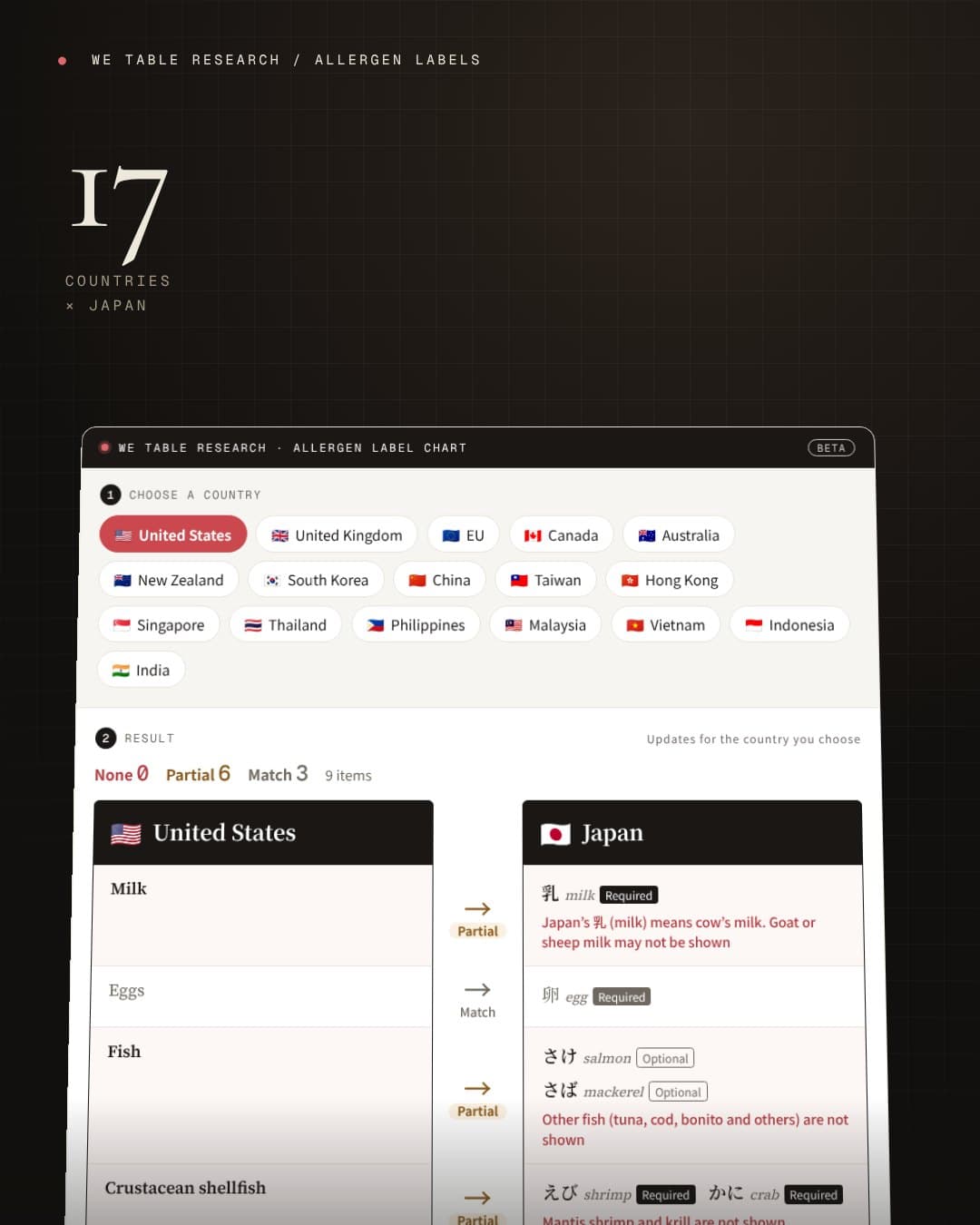
To see Japan’s 29 label allergens and how they differ from labels abroad, use the Japan allergen list. To explain your allergy in a restaurant, see how to explain food allergies at restaurants in Japan. Japanese labels may leave out the “recommended” items. For the labeling rules, see Japan’s allergen labeling rules. For allergens that don’t appear on labels, see hidden allergens on Japanese food labels.
The data on this page is published as cross_chart.json under CC BY 4.0 (credit: WE TABLE).
Read next

Questions people ask
What is food allergy cross-reactivity?
It is when IgE antibodies made against one food or pollen also bind to a similar-shaped protein in something else, and cause symptoms. Closely related plants often have similar proteins, but it also happens between distant groups, such as pollen and fruit, or dust mites and shrimp.
If I am allergic to kiwi, what else should I watch for?
The most reported are fruits linked to latex, such as banana and avocado, natural rubber (latex) itself, and birch and alder pollen. How likely a reaction is varies a lot by person and by protein, so check the chart and talk to your doctor.
My blood test was positive for kiwi and negative for apple. Does that mean no cross-reaction?
No. A negative result lowers the chance but does not make it zero. Fruit test extracts can lose fragile proteins, and one study found that only about half of people with kiwi allergy test positive on a standard test. A positive result alone does not prove an allergy either. Decide together with an allergy specialist.
If I am allergic to shrimp, can I eat crab?
In a Japanese study, 64.7% of people with shrimp allergy who had eaten crab also reacted to crab. A US estimate puts the rate from one crustacean to another at about 75%. These are often avoided together.
Does cooking stop cross-reactions?
It depends on the protein. PR-10 and profilin, the pollen-related proteins, break down with heat, so many people can eat cooked fruit. LTP, GRP, tropomyosin, parvalbumin and nut storage proteins resist heat, so cooked food can still cause a reaction.
Sources
- Committee for the Guide for the Clinical Management of Food Allergy 2023 (Health, Labour and Welfare Sciences Research Group; principal investigator Motohiro Ebisawa): Guide for the Clinical Management of Food Allergy 2023 (web edition, April 2026)
- Sicherer SH. Clinical implications of cross-reactive food allergens. J Allergy Clin Immunol (2001) (the review behind the US estimates)
- Brough HA, et al. Defining challenge-proven coexistent nut and sesame seed allergy. J Allergy Clin Immunol (2020)
- Shrimp allergy and cross-reactivity with crab and squid (Japanese study, 2006)
- Tests and components in 311 people with kiwi allergy (European study, 2013)
- Birch pollen allergy, soy milk and Gly m 4 (Hokkaido, 2015)
- Tree nut allergy in children with peanut-only allergy (Australian population cohort, 2019)
- Gromek W, et al. Revisiting Latex-Fruit Syndrome after 30 Years of Research. J Clin Med (2024)
- Prevalence of birch pollen allergy and oral allergy syndrome among residents of Hokkaido (Auris Nasus Larynx, 2026)
- Cross-reactivity in fish allergy: double-blind food challenges (J Allergy Clin Immunol, 2017)
- Co-sensitization among legumes (Front Allergy, 2023)
- Differences in parvalbumin content between fish species (Int Arch Allergy Immunol, 2010)
- Fish and chicken cross-reactivity: a new clinical syndrome (Allergy, 2016)